)
AuAg Critical Insights | Geo-economics (part two) – CRMA and investments in a changing commodity market
In an era marked by geoeconomic securitisation, fragmentation, and economic power projection, access to critical raw materials has gained growing strategic importance.
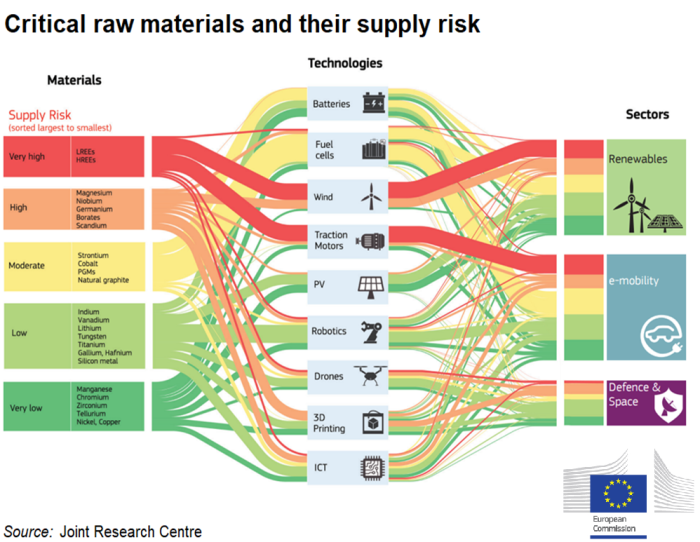
The European Union is currently heavily dependent on imports from non-EU countries. In 2024, for example, Turkey supplied 98 percent of the EU's boron, while China accounted for 100 percent of the Union's supply of heavy rare earth elements, such as europium, terbium, and yttrium.
In this context, the EU's Critical Raw Materials Act (CRMA) entered into force in 2024. It aims to secure access to critical and strategic raw materials needed for the EU's green, digital, and security-related ambitions—through increased self-sufficiency, diversified import flows, and strengthened resilience.
CRMA in a global geoeconomic context
The Critical Raw Materials Act (CRMA) is not an isolated initiative. It is part of a broader global trend in which the formerly globalised trade in raw materials is replaced by more regional and politically governed systems, where control over supply chains has become a strategic objective. Leading economies such as the United States, Japan, Canada, South Korea, and Australia are now pursuing active raw material strategies, increasingly linking resource supply to national industrial policy, security, and strategic autonomy.
CRMA thus represents the EU's response to a new reality in which access to strategic inputs can no longer be taken for granted, but is subject to global competition, geopolitical manoeuvring, and deliberate economic governance. For example, over the past year, the EU has become increasingly aware of the strategic risks associated with dependence on Chinese suppliers of rare earth elements—used in electric vehicle batteries, wind turbines, electronics, and the defence industry.
In April 2025, China introduced new regulations that severely restricted the export of at least seven types of rare earth elements and magnet components. As a result, the value of these exports dropped by approximately 75%, meaning that significantly less of these critical materials could be shipped from China to other countries. This caused major disruptions, particularly for the EU's automotive and electronics industries.
Ahead of the upcoming EU–China summit at the end of July, the European Commission has actively called for fair and transparent administration of China's export licensing system in order to safeguard stable supply chains.
A new perspective on economy and security
The Critical Raw Materials Act (CRMA) is not merely a concrete piece of legislation, but also a clear reflection of a broader systemic shift in how the EU perceives the relationship between economy, politics, and security. The new raw materials logic embodied by CRMA is strongly echoed in the EU's Strategic Agenda for 2024–2029, where concepts such as resilience, critical dependencies, hyper-competition, vulnerability, and systemic risk have taken centre stage.
As a result, terminology traditionally associated with defence and crisis policy has become an integral part of the EU's industrial policy vocabulary. This shift sends a clear message to citizens and investors alike: the world has changed, the old rules no longer fully apply, and strategic control over raw materials, technology, and production has become a necessity rather than a choice.
What does CRMA mean in practice?
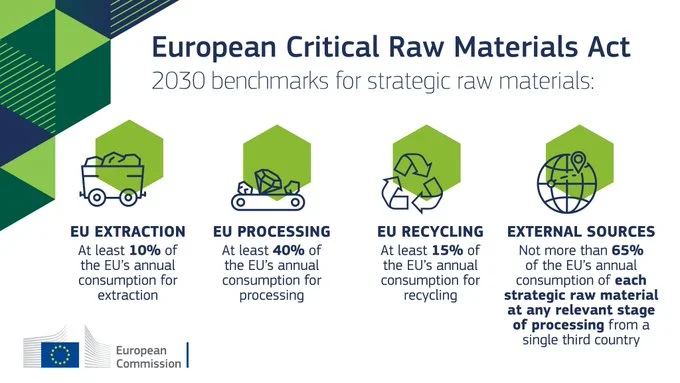
To ensure access to the critical raw materials necessary for the green, digital, and security-related transitions, the EU has established binding benchmarks for how much of its strategic material needs must be met by 2030 through resources extracted, processed, and recycled within the Union:
- At least 10% of the EU's annual demand for strategic raw materials must be met through domestic extraction.
- At least 40% must be processed within the EU.
- At least 25% should come from recycled materials.
- No more than 65% of strategic raw material may come from a single third country.
In addition, the EU is strengthening its monitoring of supply risks. Among other measures, regular stress tests of strategic supply chains will be introduced to identify vulnerabilities early. At the same time, each Member State must develop national exploration plans to map potential deposits within their territory, thereby contributing to the Union's goal of increasing self-sufficiency.
Strategic projects and partnerships as tools
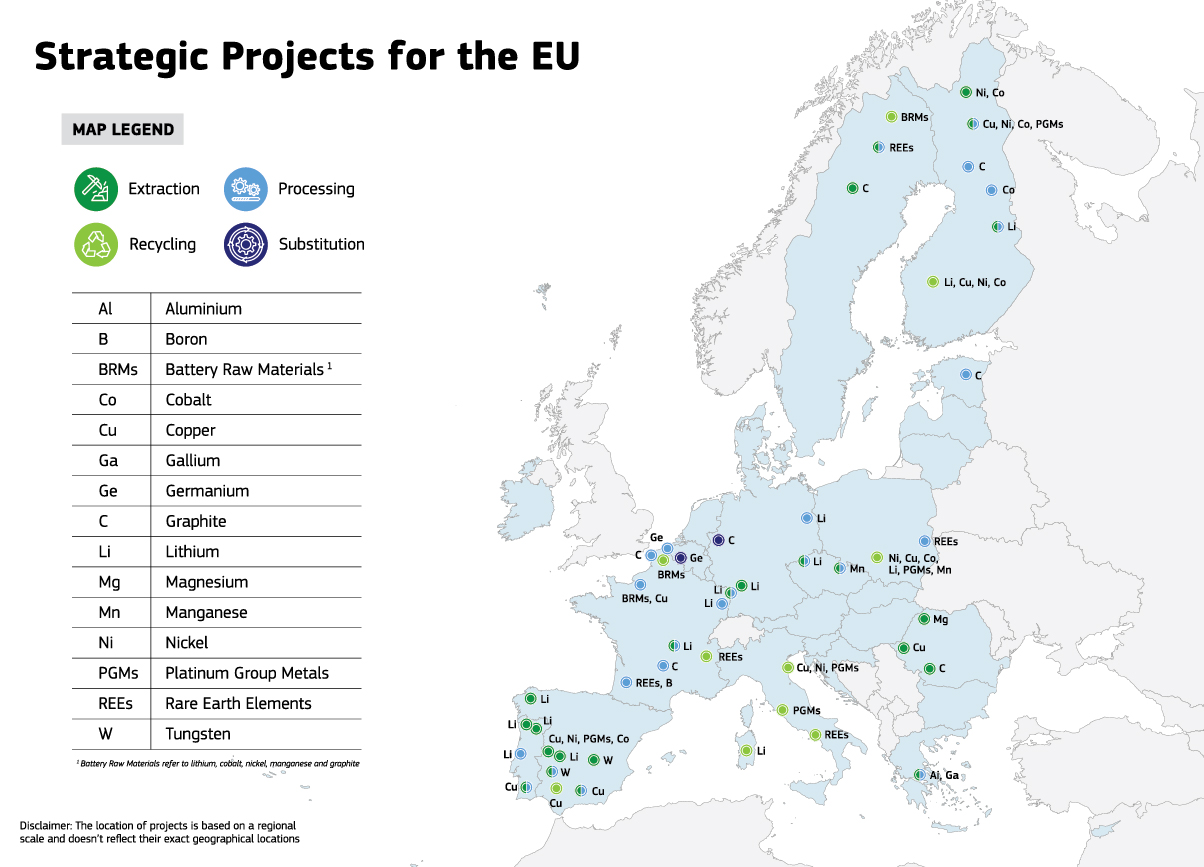
To rapidly build new capacity and meet the 2030 targets, the CRMA prioritises so-called strategic projects designated by the Commission. These initiatives—related to the extraction, processing, recycling, and substitution of critical raw materials—are considered to be of overarching public interest. This means they can, in some cases, take precedence over other societal interests. As a result, they benefit from accelerated permitting processes and special priority in public administration. For example, permits for extraction projects must be granted within a maximum of 27 months, while permits for processing and recycling projects must be granted within a maximum of 15 months. Several strategic projects have already been approved. On March 25, 2025, 47 strategic projects within the EU were approved, and on June 4, 2025, an additional 13 projects outside the EU were approved, bringing the total to 60 strategic projects.
CRMA also emphasises the importance of strategic partnerships with third countries. These partnerships are a central tool of the CRMA for securing the EU's access to critical raw materials and reducing dependence on individual suppliers. Through partnerships with countries such as Canada, Ukraine, Namibia, Kazakhstan, Argentina, Chile, Zambia, and the Democratic Republic of Congo, the EU is building long-term collaborations that go beyond trade. They also include joint investments, technology transfer, and local value creation in the partner countries. The aim is to create redundancy in supply chains and promote a long-term, sustainable, and socially responsible supply of raw materials.
Strategic projects and partnerships as key instruments
To rapidly build new capacity and meet its 2030 targets, the CRMA prioritises so-called Strategic Projects designated by the European Commission. These initiatives—focused on the extraction, processing, recycling, and substitution of critical raw materials**—**are considered to be of overriding public interest. This designation allows them, in certain cases, to be prioritised over other societal interests. It also enables accelerated permitting procedures and grants these projects special priority in public administration. For instance, permits for extraction projects may take no longer than 27 months, while those for processing and recycling projects are limited to 15 months.
Several Strategic Projects have already been approved. On March 25, 2025, the Commission approved 47 Strategic Projects within the EU, and on June 4, 2025, an additional 13 projects outside the EU were approved, bringing the total to 60 Strategic Projects.
The CRMA also underscores the importance of Strategic Partnerships with third countries. These partnerships are a central tool for ensuring the EU's access to critical raw materials and reducing reliance on individual suppliers. Through agreements with countries such as Canada, Ukraine, Namibia, Kazakhstan, Argentina, Chile, Zambia, and the Democratic Republic of Congo, the EU is building long-term collaborations that go beyond trade. They include joint investments, technology transfer, and local value creation in partner countries. The goal is to create redundancy in supply chains and promote a sustainable and socially responsible raw materials supply over the long term.
CRMA's Investment Logic: New Rules for the Raw Materials Market
"CRMA represents a structural shift in the raw materials market, where political and strategic factors are gaining increasing importance."
We are witnessing a growing global focus on minerals and metals, where these raw materials are increasingly linked to industrial policy, national security, and strategic autonomy. At the same time, the green transition is driving structural demand for many of these metals, while a fragmented geopolitical landscape increases the risk of regional restrictions, trade barriers, and the securitisation of raw material supply chains.
An increased emphasis on domestic production may also result in higher costs, which could in turn push up prices for certain metals. Strategic materials in particular are exposed to being used as political tools, heightening the risk of sudden supply disruptions and sharp price shocks.
Together, these factors create a new structural investment climate in metals and minerals that are vital to the energy systems, technologies, and societal development of the future.
We at AuAg continuously monitor global commodity developments and recognise that what is considered critical and strategic evolves over time. We constantly assess which metals are central in the current geopolitical and technological landscape, offering focused exposure to this growing and long-term strategic market.
Through an active and global investment strategy, AuAg adapts its portfolio to seize opportunities in critical materials, even beyond today's definitions under CRMA. In a rapidly changing geoeconomic reality, the ability to understand and navigate shifts in the raw materials market is becoming a decisive competitive advantage.
AuAg Essential Metals actively tracks, analyses, and invests in the new raw materials logic, where flexibility and insight into the shifting global order are key to long-term success.
By AuAg Funds
References
European Commission. (n.d.). Critical raw materials act. Retrieved June 2025, from: Single Market Economy
European Council. (2024). *The European Union's Strategic Agenda 2024–2029: *Consilium
Hool, A., Helbig, C., & Wierink, G. (2024). Challenges and opportunities of the European Critical Raw Materials Act. Mineral Economics, 37(3), 661–668: DOI
Reuters. (2025, June 4). Some European auto supplier plants shut down after China's rare earth curbs. Reuters.
Reuters. (2025, July 2). EU presses China on rare earths and Ukraine war ahead of summit. Reuters.
Transport & Environment. (2023). EU strategic partnerships: How to shape secure, diverse and sustainable trade in critical minerals. [Briefing].

)
)
)