)
May monthly letter | “The Petrodollar just cracked”
Elements is AuAg's monthly letter highlighting macroeconomic observations from the previous month. Our focus is on events that impact the investment environment for gold, silver and other essential metals. These observations are presented with images and charts laid out efficiently and concisely.
Au and Ag in the past month
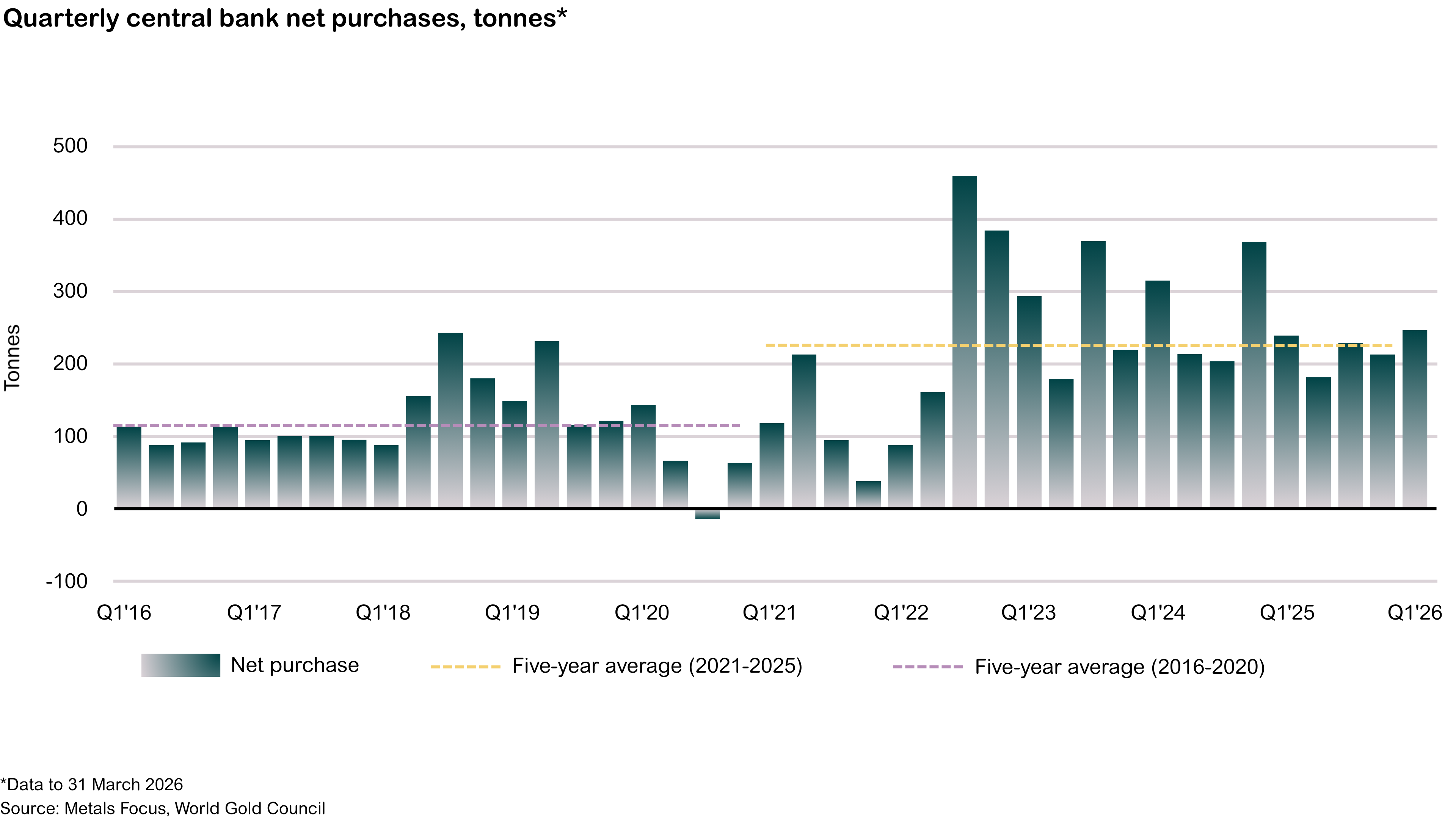
The gold price closed the month at USD 4,621 (USD 4,672), down −1%. We are now back at the levels of the all-time highs set in mid-January and “only” +7.1% for 2026. The correction from the levels just before the Iran war broke out has now flushed weak hands out of the market, along with speculative commodity traders who have shifted positions out of gold and into the major opportunities created by the now-volatile oil market. Central banks, by contrast, continue to be net buyers of gold at the same elevated pace as over the past five years.
 Our forecast of USD 6,000+ remains in place and would imply gains of close to +30% over the next 8 months. The latest big bank, Wells Fargo, recently came out with an updated forecast that even pointed to USD 8,000 as a possibility.
Gold Price per Troy-Ounce (oz) in USD
The silver price fell to USD 73.76 (USD 75.14) over the month, a decline of −1.8%. Silver, too, is now back where we started the year, with a gain of just +3.4%. That leaves room for substantial upside through the rest of the year.
In our 2026 Outlook, we set a long-term target for silver of USD 300 and a 2026 target of USD 133. The upside today would therefore be roughly +80%, compared with +30% for gold. The 2026 target may look high today, but we are not alone — Bank of America has issued one of the boldest silver calls. Michael Widmer, the bank’s commodity strategist, predicts silver could reach between USD 135 and USD 309 per troy ounce before the end of 2026.
After two months of the Iran war, we are entering a new phase of economic stimulus to shield the world economy, which has been hit hard — not least by disruptions to oil supplies. What we wrote about in last month’s letter is now beginning: rising debt and money printing, and this is what will drive the next big leg up in gold and silver prices.
Silver Price per Troy-Ounce (oz) in USD
The companies continue to demonstrate enormous strength. Industry giant Newmont recently reported USD 3 billion of free cash flow for the first quarter of 2026. They also showed that only 6% of their operating costs come from diesel and that they do not foresee any operational disruptions stemming from the current situation.
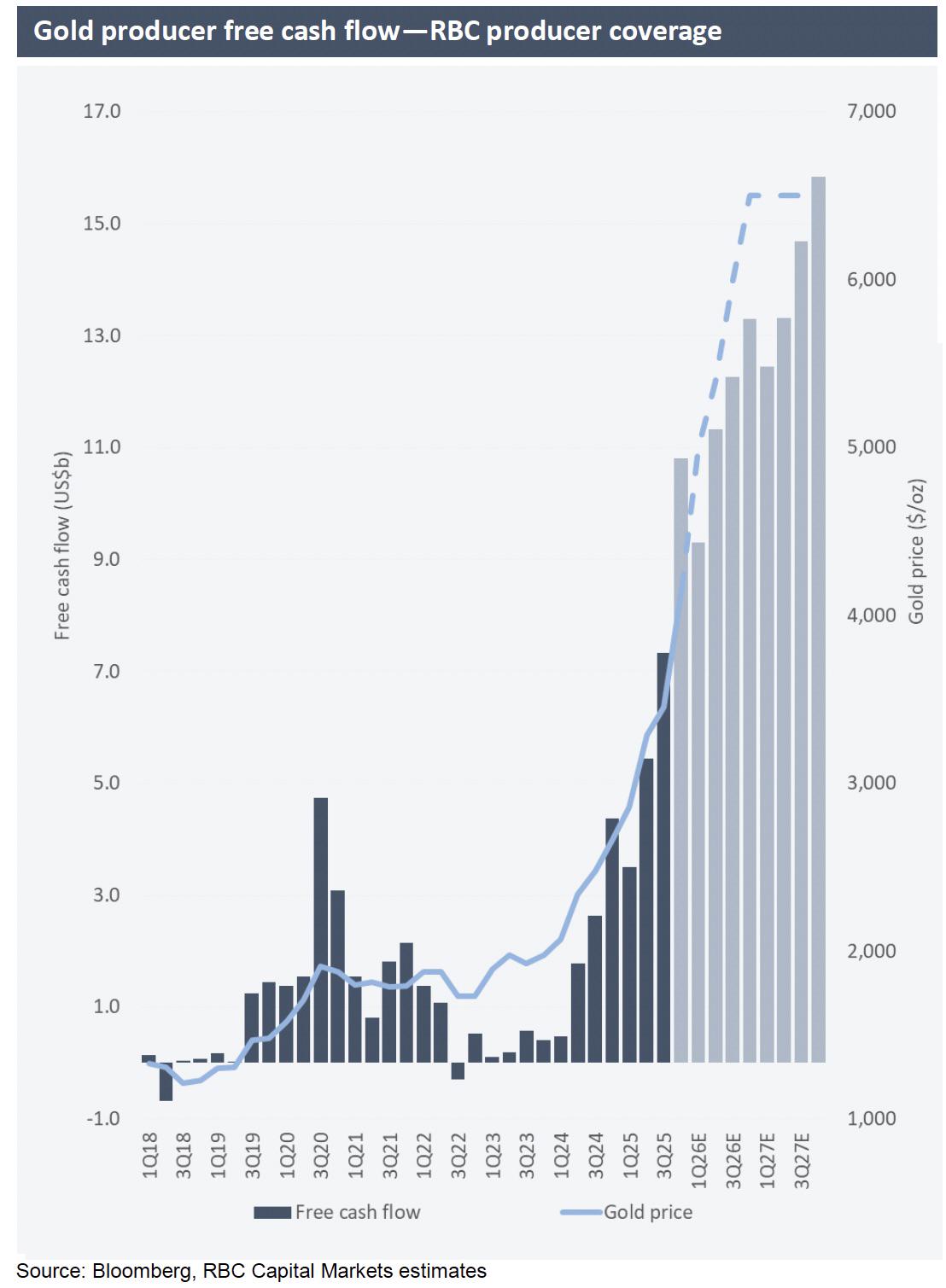
We would not be surprised to see a rotation of capital into the mining sector, as valuations point to a very attractive entry compared with other sectors. The charts below show gold mining companies under four different scenarios for the gold price.
The first chart shows FCF/EV (Free Cash Flow / Enterprise Value), a valuation multiple that compares a company’s actual free cash flow with its total value (including debt). You want this number as high as possible.
The second chart shows EV/EBITDA (Enterprise Value / Earnings Before Interest, Taxes, Depreciation, and Amortization), a valuation multiple used to assess a company’s total value (Enterprise Value) relative to its operating cash flow (EBITDA). You want this number as low as possible.
)
The AuAg funds - Highlights
Multi-asset funds have long been an important building block in many portfolios. At the same time, they don’t get much attention because, by their very design, they almost never top a performance ranking. A well-built multi-asset fund holds assets with low correlation to one another, where one part offers solid return potential and the other acts as a shock absorber — above all when equity markets are weak.
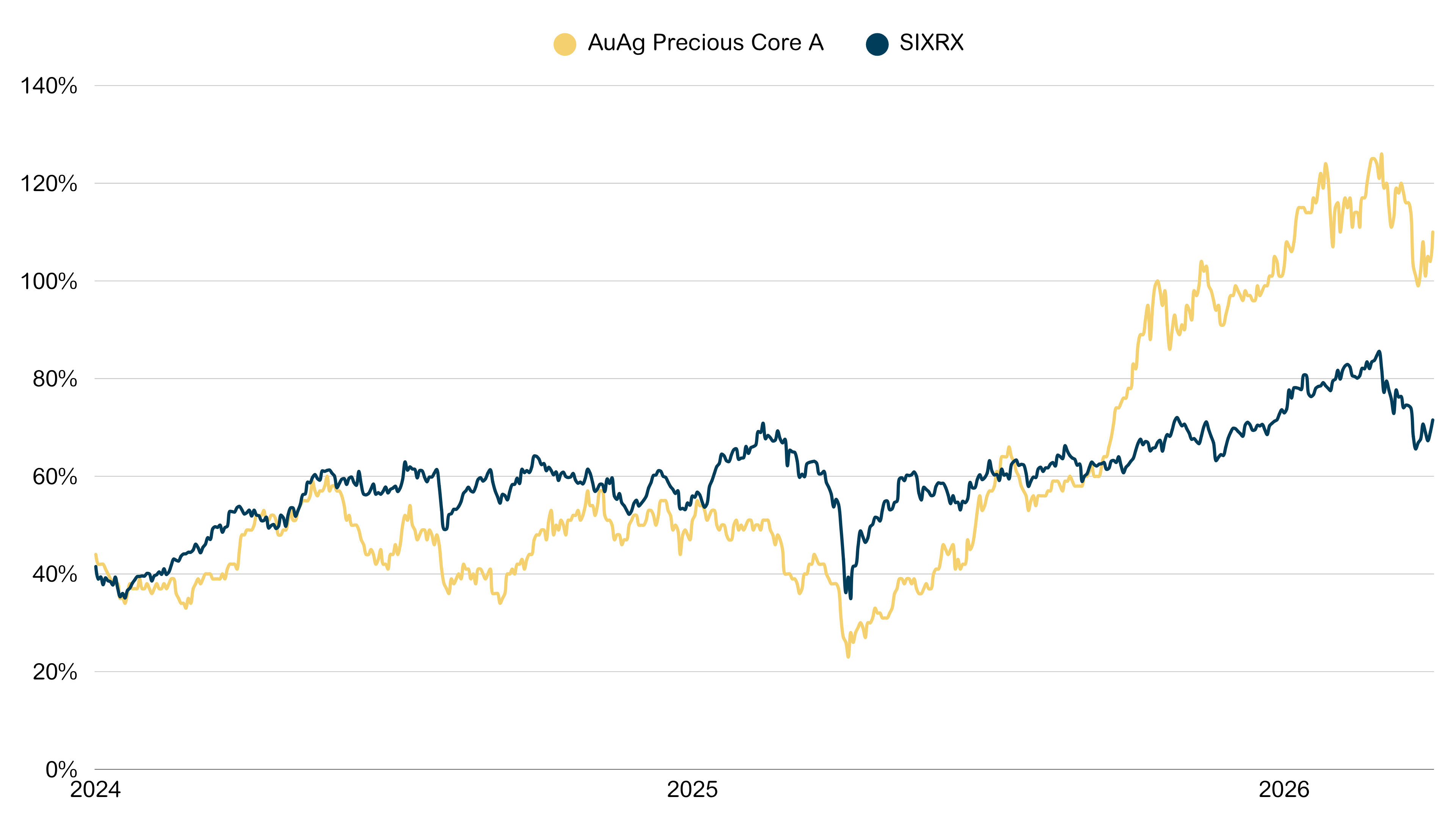
AuAg Precious Core is a unique fund. So unique, in fact, that Morningstar can’t even classify it. This multi-asset/hedge fund outperforms most of the funds in its segment, and has even beaten the equity market since its launch on 1 September 2020.
The chart below also shows that it moves differently from the equity market — and does so without being a dull, non-performing airbag. Its low correlation with equities, around 0.35, makes the fund a strong complement to, for example, a global equity fund. And yes, it pairs equally well with a fixed-income fund if you still want to hold one in the portfolio.
AuAg Precious Core has a CAGR of over 14.28% for share class A (13.41% for share class B) and, riding a strong tailwind, has returned +62.64% in SEK over the past year (12 months) (+64.92% in EUR).
Global Outlook with AuAg
We have already been seeing de-globalisation, with more and more countries and regions wanting to become more self-sufficient when it comes to critical metals. The Iran war and its knock-on effects — above all on oil — have now exposed further risks of being dependent on the rest of the world. Once again, countries will need to take stock of where they stand, this time on energy supply as well. We expect even larger investments in nuclear power and electrification in the years ahead.
Sharply higher oil prices and supply disruptions are putting the world under strain, and will force countries to act if they continue. Rationing, and stimulus to offset the slowdown in consumption that follows higher gasoline and diesel prices, look likely. It is precisely this stimulus and money printing that will give gold and silver prices a tailwind once the market truly grasps what is happening.
During the 1970s, the United States built a world order that came to be known as the Petrodollar. It rested on the U.S. dollar’s status as the world’s reserve currency and on an agreement with Saudi Arabia to supply oil — with the further understanding that all oil trade worldwide would be settled in USD. Any country that tried to break out of this system was quickly subjected to American “measures.”
Today, the U.S. has itself become a major oil producer, and its dependence on Saudi Arabia has accordingly diminished. During the Iran war, Washington has not focused on protecting the oil-producing countries, and these countries now feel let down compared with what they had been led to expect under their arrangement with the U.S. and the Petrodollar.
The Petrodollar is now cracking, with more and more countries trading oil in currencies other than the dollar. The short-term gains for the U.S. are likely to lead to far greater losses down the road. The privilege of having oil-producing countries sell oil in dollars and recycle the proceeds into U.S. Treasuries is over. Who is now going to finance America’s enormous budget deficit and debt? The U.S. itself — through the Fed’s printing press.
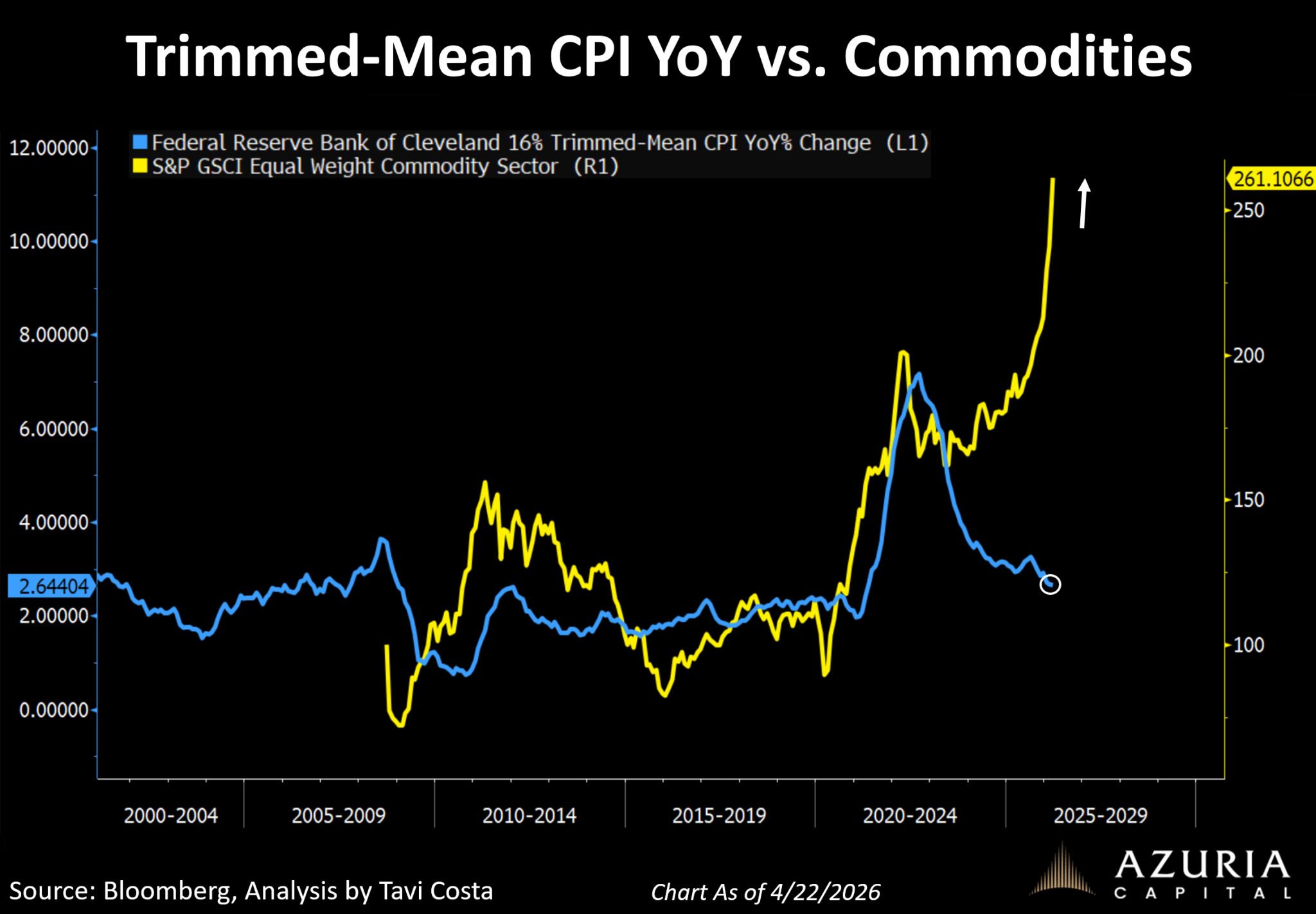 President Trump’s rate cuts are also drawing closer, even if many in the market would like to believe otherwise. The new Fed Chair is now bringing a refined view of how to read inflation — “trimmed mean inflation”. This approach strips out both the highest- and lowest-impact items when measuring inflation. Once again, calculations are done in a different way to provide a new basis for future rate decisions.
So we are not looking at higher rates because of inflation, but rather lower rates designed to counter all the negative effects of oil prices — by leaving oil-price moves out of the inflation measure. We now hope the war can soon be brought to a complete end, and that all the measures from central banks and governments can finally get under way. We are ready — buckle up.
This material is marketing communication. The information does not constitute investment advice or a personal recommendation. Investment decisions should be based on the fund’s information brochure and fact sheet, as well as your own considerations.
Investments involve risk. Past performance is not a guarantee of future returns. The money invested in the fund may both increase and decrease in value, and it is not certain that you will recover the entire amount invested.
Before making an investment decision, you should review the fund’s information brochure and fact sheet, available under Documents on the respective fund page at www.auagfunds.com.
Be part of the journey
More than 100,000 investors across Europe have invested in the AuAg funds.
)
)
)
)
Featured content this month
Explore our "Research centre" to take part in our current view of the market and the macro environment. We continuously update with new articles and publications. Here are some of the latest entries:
)
)
)
