)
Is the silver bullet the solution to the problem?
Elements is AuAg's monthly letter highlighting macroeconomic observations from the previous month. Our focus is on events that impact the investment environment for gold, silver and other essential metals. These observations are presented with images and charts laid out efficiently and concisely.
Intro
May was marked by stability in gold and renewed momentum in silver. The gold price remained near previous highs, while silver surged and is approaching technically essential levels. At the same time, the US dollar has weakened noticeably, reflecting market expectations of upcoming rate cuts in the United States.
Despite high interest rates and a previously strong dollar, gold's resilience underscores its role as a hedge in an uncertain monetary landscape.
As we enter June, the silver price has broken through 35 USD, trading around 36 USD per troy ounce. Driven by silver’s strong momentum recently, the AuAg Silver Bullet fund has also seen a sharp rise, surpassing NAV 200 and reaching NAV 210. Thanks to this development, but above all thanks to you, our investors and ambassadors, AuAg has now surpassed SEK 2 billion in assets under management.
We hope you’ll all raise a glass with us today to celebrate these significant milestones on our shared journey. A journey that has only just begun!
In this monthly letter, written by the end of May, we summarize market developments, highlight the funds’ performance, and provide a forward-looking perspective that has, in part, already begun to be realized.
Gold and Silver during the previous month
The gold price closed the month at USD 3,290, almost exactly the same level as the previous month. Although it didn’t set a new all-time high, gold did briefly trade above USD 3,400 per troy ounce.
The silver price ended May at USD 33.00 precise, marking a modest gain of +1.2%. Silver continues to build momentum in the 32–33 range and now appears ready to move toward 35, which could pave the way for significant gains.
The US dollar has dropped sharply at the start of 2025, returning to levels seen before the Fed began its fastest rate hike cycle in modern times. This weakening is partly due to the market already pricing in a rate-cutting cycle in the US. Central banks often raise rates too late, and then lower them too late as well. This is commonly described as “being behind the curve.” What’s notable this time is that the Fed, which normally leads the way when it comes to shifts in policy direction, is now likely to be the last to start cutting rates.
The fact that gold has performed strongly during the rate hike cycle, the period of dollar strength, and now at the start of the next cycle says a lot about the underlying force of monetary inflation. Everyone expected gold to fall when rates went up, but now, three and a half years later, gold is showing a gain of over +83.3%. After such a strong rally, it's natural to ask whether gold is expensive now. According to our models, gold is still undervalued below USD 4,290, which suggests there is still room for further upside.
We also note that central banks continued to be net buyers of gold during the first quarter of 2025. The level of buying was slightly above the average for quarterly purchases over the past five years.
AuAg Funds – Highlights
AuAg Silver Bullet once again surpassed NAV 180 during the month. It’s now time to set sights on reaching NAV 200.
AuAg Silver Bullet doesn’t move in sync with the stock market—it sometimes falls when the market rises and rises when the market falls. This quality makes the fund a strong addition to a diversified portfolio. When building a portfolio, low correlation between funds is key. AuAg Silver Bullet has a correlation of just 0.21 with the Stockholm stock market, which means that even though it has a high risk classification, adding it can actually reduce the overall portfolio risk.
Looking at the fund’s performance from launch until now, it has slightly outperformed the Stockholm stock market including dividends (OMX30). The fund’s gain of +80.6% compares to the market’s +69%. It has also delivered more than twice the return of silver itself, and even 20% more than gold—which has performed very strongly in recent years.
What we see as a very strong start to this bull market is that commodity prices are not only high but, more importantly, stable—and that the companies are being managed much better than in the past. In last month’s letter, we noted that AuAg Gold Rush had significantly outperformed the gold price this year (as of month-end: +33.4% vs. +7.2%—a 4.6x difference). If we apply the same perspective to AuAg Silver Bullet, the X-factor becomes a bit harder to calculate... +21.1% versus -4.0% for silver in SEK this year.
Of course, we’re talking about “Sweden’s most high-risk fund” (most volatile), so sharp swings can happen quickly. But we believe that upcoming fluctuations are more likely to play in AuAg Silver Bullet’s favor, given the current global outlook. Our first major milestone is NAV 1000—only then will it be time for a real celebration! See the image below from when Realtid.se picked up the news about the launch of AuAg Silver Bullet. The article became the most-read piece on Realtid.se in 2019.
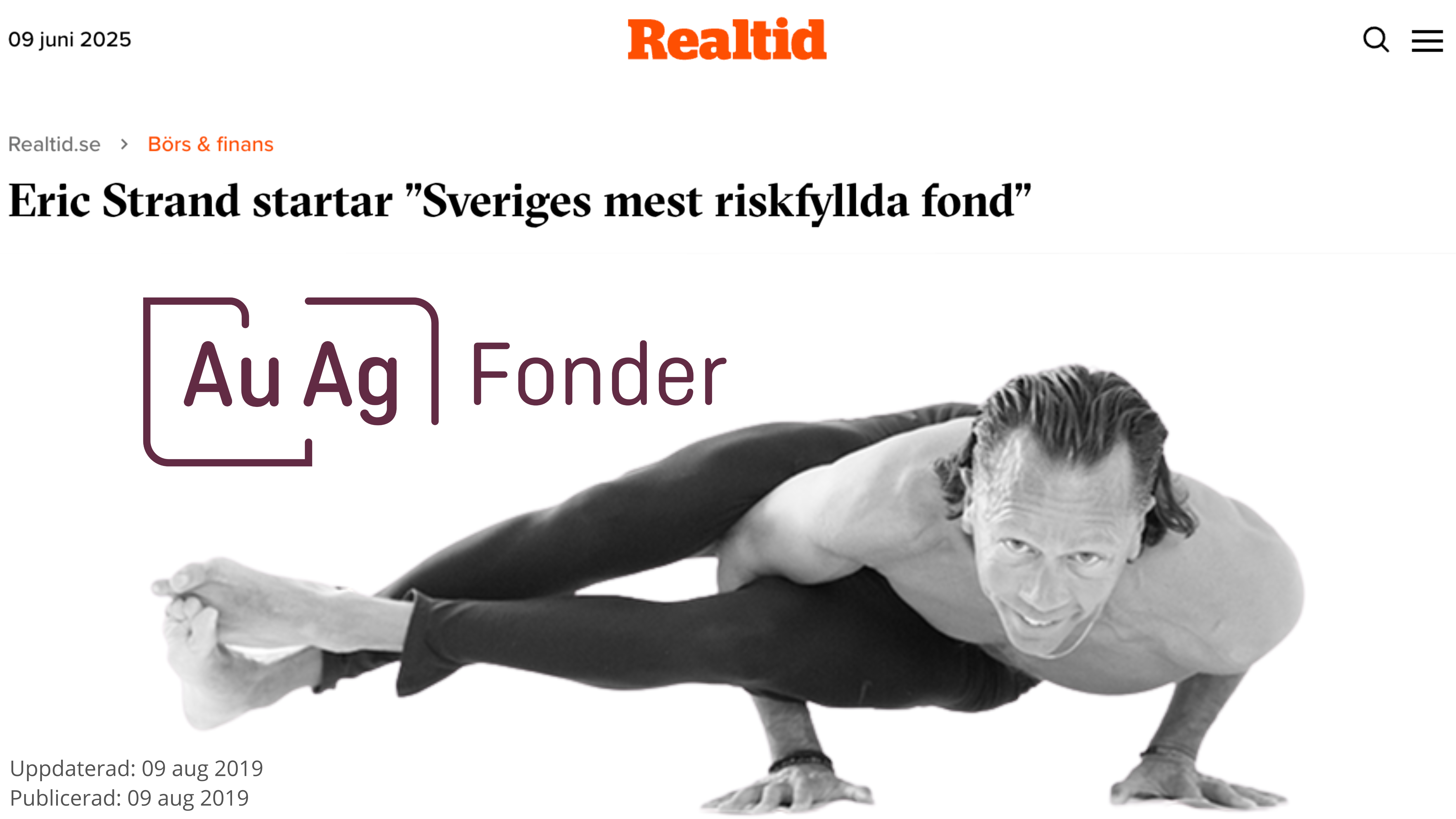
We also made a portfolio update in the fund on May 7, increasing our exposure to a few of our smaller holdings. Even though these positions are now in the 4% and 2% categories, we must admit we've had a bit of luck in adding and increasing these companies since the start of the year. Read more about the fund’s latest portfolio update here:
Global Perspectives with AuAg
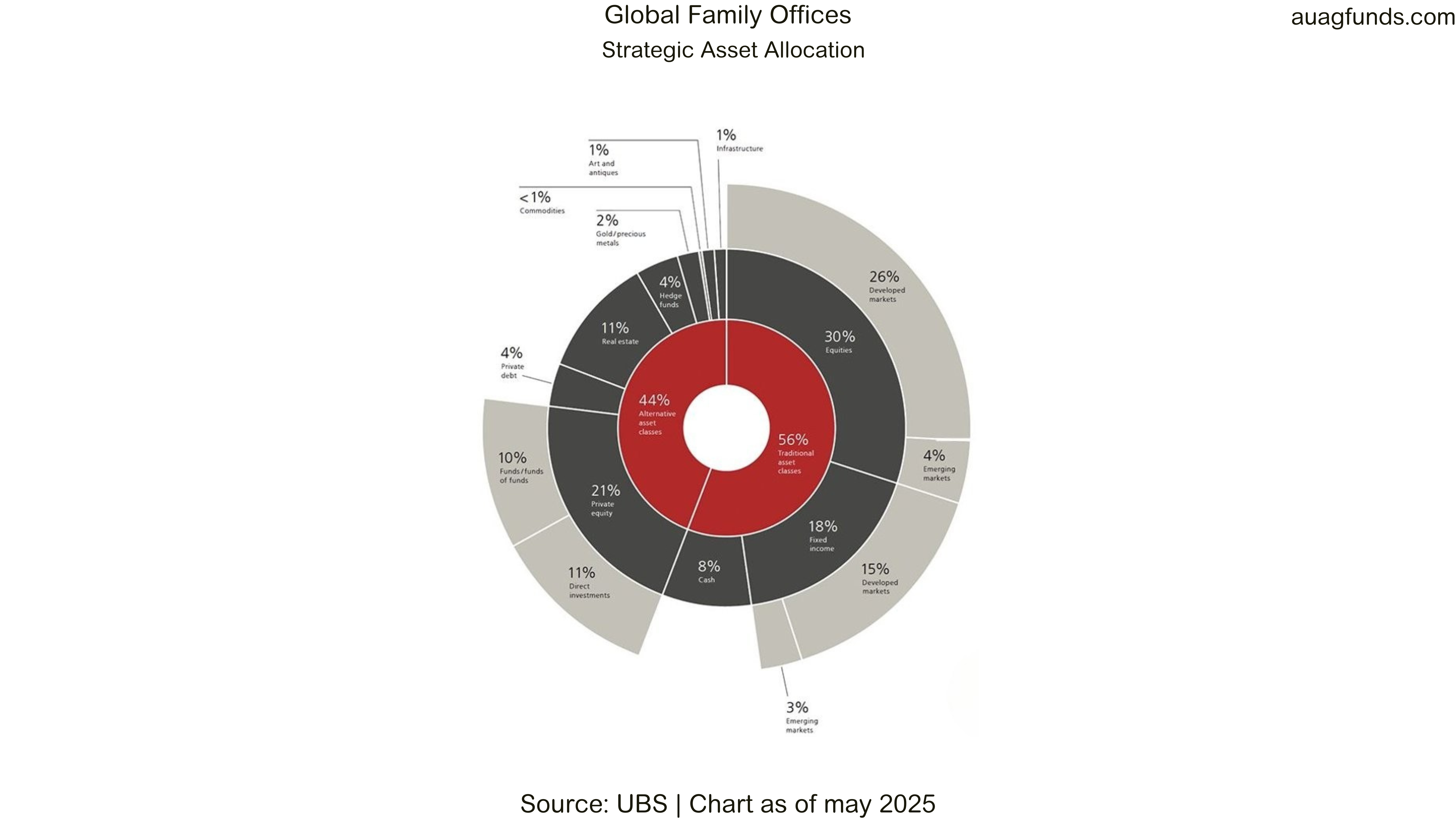
Investors around the world see gold as overbought—yet they own very little of it. This is a fascinating phenomenon where the investor collective “believes” one thing, while in reality gold remains extremely under-owned in portfolios globally. We see tremendous potential in sectors that currently have a 1–2% allocation but should have at least 5%. These are the sectors that stand to benefit most from the capital rotation ahead. Then there are the smart investors who always keep at least 15% in commodities—like Ray Dalio’s Bridgewater, one of the world’s largest hedge funds, managing around USD 100 billion.
Are tariffs back on the table? What’s going on? New 50% tariffs on steel imports to the US have now been introduced. Global steel production over the past five years has hovered around 2,000 million tonnes per year—twice as much as 20 years ago. The US is the world’s largest net importer, while Russia and Japan are the largest net exporters.
Did you know that steel isn’t an element or a “pure metal”? Steel is actually an alloy, primarily made from the pure metal iron. During steel production, carbon acts as a binding agent. The amount of carbon (typically 0.5%–2%) in the alloy determines the properties of the steel. Steel with higher carbon content can be made stronger, harder, and more elastic than iron—but it also becomes more brittle. Steel can also be alloyed with other elements: manganese increases strength and heat resistance, while chromium and nickel make the steel stainless.
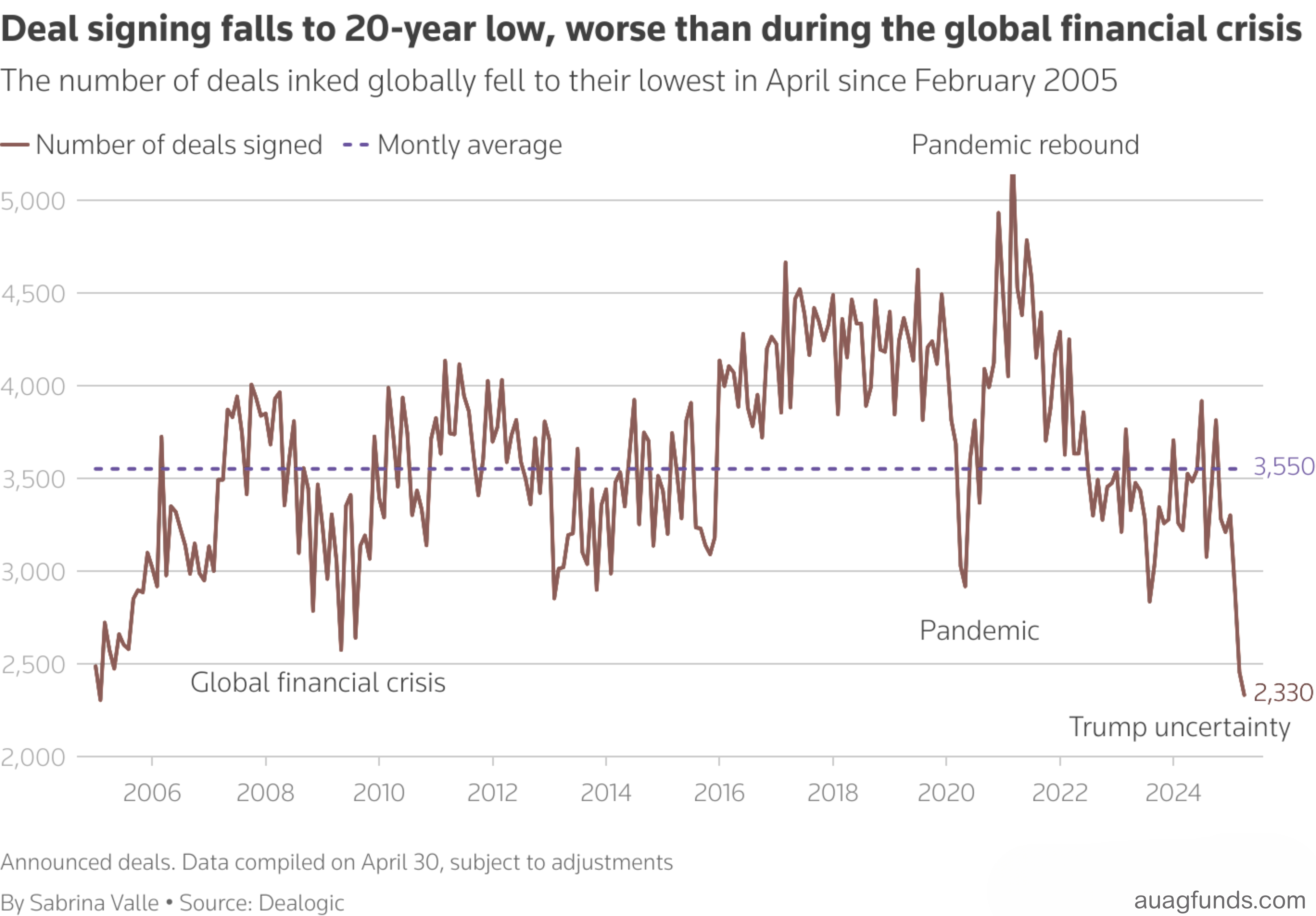
The uncertainty around tariffs, on, off, and then on again, has consequences. We’re now seeing that the number of signed corporate deal transactions is at a record low. Even lower than during the Covid crisis and the global financial crisis. This cocktail of total uncertainty, combined with the recent downgrade of the US credit rating by Moody’s and the high costs of financing both existing and new deficits, could have a significant impact on the market in the year ahead.
Be part of the journey
More than 100,000 investors across Europe have invested in the AuAg funds.
)
)
)
)
Featured content this month
Use our unique "Research Centre" on an ongoing basis to take part in our current view of the market and the macro environment. We communicate all the time. Here are a few media links from the past month:
)
)
)
